Table of Contents
- 1.1 Introduction & Overview
- 2. The Model with Updated Biomass
- 3. Optimal Control Problem
- 4. Case: Jointly Updated Biomass and Growth Rate
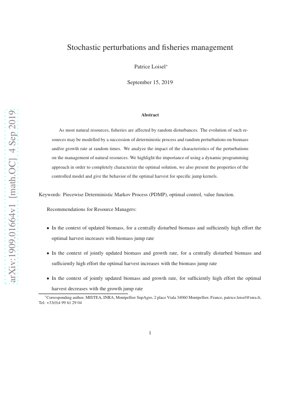
- 5. Key Results & Managerial Insights
- 6. Technical Analysis & Mathematical Framework
- 7. Analytical Framework: Example Case
- 8. Future Applications & Research Directions
- 9. References
1.1 Introduction & Overview
This paper addresses a critical challenge in natural resource management: accounting for random, discrete disturbances. Unlike many models that assume continuous noise or regular interventions, this work models fisheries biomass evolution as a Piecewise Deterministic Markov Process (PDMP). Between random perturbation events, biomass follows a deterministic growth curve (e.g., logistic growth). At random times following a Poisson process, the biomass (and potentially its growth rate) undergoes an instantaneous jump or update. The core research question is how the characteristics of these stochastic perturbations—specifically their jump rate $λ$—influence the optimal harvest policy.
2. The Model with Updated Biomass
2.1 Deterministic Growth Dynamics
In the absence of perturbations, biomass $x(t)$ evolves according to: $$\frac{dx(t)}{dt} = G(x(t)) - h(x(t), e(t)), \quad x(0)=x_0 \in (0, K)$$ where $G(x)$ is a concave growth function (e.g., logistic $G(x)=rx(1-x/K)$), $K$ is the carrying capacity, and $h$ is the harvest which depends on biomass and effort $e(t)$.
2.2 Stochastic Perturbation Framework
Perturbations occur at random times $\tau_1, \tau_2, ...$, modeled as a Poisson process with rate $λ$. At each $\tau_i$, the biomass is updated: $$x(\tau_i^+) = Y_i \sim L(\cdot | x(\tau_i))$$ where $L$ is a conditional distribution (jump kernel) describing the post-perturbation state.
2.3 PDMP Formulation
The system state $– biomass $x(t)$ $–$ is a PDMP. Its trajectory is deterministic between jumps, governed by the ODE above. At jump times, the state resets randomly. This hybrid structure captures the essence of sudden environmental shocks or measurement updates in fisheries.
3. Optimal Control Problem
3.1 Dynamic Programming Approach
The manager's objective is to maximize the expected discounted net present value from harvesting: $$V(x) = \sup_{e} \mathbb{E} \left[ \int_0^{\infty} e^{-\rho t} \pi(x(t), e(t)) dt \right]$$ where $π$ is the profit function and $ρ$ the discount rate. The paper emphasizes that a dynamic programming (DP) approach is essential to fully characterize the optimal feedback policy $e^*(x)$.
3.2 Value Function & HJB Equation
For a PDMP, the Hamilton-Jacobi-Bellman (HJB) equation incorporates both the deterministic drift and the expected effect of jumps. In the case of updated biomass only, it takes the form: $$\rho V(x) = \max_{e} \left\{ \pi(x, e) + [G(x) - h(x,e)] V'(x) + \lambda \int [V(y) - V(x)] L(dy|x) \right\}$$ The integral term represents the expected change in value due to a perturbation.
4. Case: Jointly Updated Biomass and Growth Rate
The model is extended to a two-dimensional PDMP where both biomass $x$ and the growth rate parameter $r$ (or a related parameter) are subject to simultaneous random updates at jump times. This adds significant complexity, as the optimal policy must now respond to shifts in the underlying productivity of the resource, not just its current stock level.
5. Key Results & Managerial Insights
The analysis yields specific, testable hypotheses about how optimal harvest $h^*$ responds to perturbation characteristics:
- For updated biomass only: With a "centrally disturbed" biomass kernel and sufficiently high effort, the optimal harvest increases with the biomass jump rate $λ$.
- For jointly updated biomass and growth rate:
- With a centrally disturbed biomass kernel and high effort, optimal harvest still increases with $λ$.
- However, for sufficiently high effort, the optimal harvest decreases with the growth rate jump rate.
This implies that more frequent biomass shocks may call for a more aggressive harvest (potentially to capitalize on unexpected booms or mitigate risk), while more frequent changes in productivity warrant a more cautious approach to avoid over-exploiting a system whose regenerative capacity has dropped.
6. Technical Analysis & Mathematical Framework
Core Insight, Logical Flow, Strengths & Flaws, Actionable Insights
Core Insight: Loisel's work delivers a crucial, yet often overlooked, insight: in stochastic resource management, the optimal response to uncertainty is not monolithic. It critically depends on what is random (biomass vs. growth parameters) and the nature of that randomness (jump rate). Treating all uncertainty as variance in a continuous process, as many classical models do, can lead to dangerously suboptimal policies. The paper's punchline—that harvest should increase with biomass jump frequency but decrease with growth rate jump frequency—is a non-intuitive result that challenges blanket "precautionary principle" approaches.
Logical Flow: The argument is elegantly constructed. It starts from the realistic premise of discrete, Poisson-distributed shocks (e.g., storms, disease outbreaks, sudden policy changes) rather than the mathematically convenient but less realistic continuous Brownian motion. It then rigorously frames this within the PDMP paradigm, a powerful but underutilized tool in economics. The dynamic programming formulation naturally leads to an HJB equation that explicitly separates deterministic drift, control, and jump effects. Analyzing this equation under specific kernel assumptions ($L$) yields the comparative statics with respect to $λ$.
Strengths & Flaws: The major strength is its conceptual rigor and appropriate tool selection. Using PDMPs is the "right tool for the job" for modeling discrete stochastic events, a point emphasized in operations research literature like the seminal work by Davis (1993). It moves beyond the limitations of stochastic differential equations (SDEs) for this problem class. However, a significant flaw is the lack of empirical calibration or numerical simulation. The results are analytical and qualitative. The paper doesn't show *how much* harvest should change for a given change in $λ$, which is what a resource manager truly needs. Furthermore, the assumption of a specific "centrally disturbed" kernel, while analytically tractable, may not hold in all real-world scenarios. The model also sidesteps the substantial challenge of estimating the jump rate $λ$ and kernel $L$ from noisy, sparse fisheries data—a problem where Bayesian state-space models, as used in works like Meyer & Millar (1999), would be necessary complements.
Actionable Insights: For practitioners and regulators, this research mandates a shift in monitoring and assessment. Don't just estimate an average biomass or growth rate with confidence intervals. Actively try to characterize the shock process: Are perturbations primarily to stock size (e.g., illegal fishing pulses) or to productivity (e.g., regime shifts in ocean temperature)? Implement monitoring systems that can distinguish between these and estimate their frequencies. Management strategy evaluation (MSE) simulations, a gold standard in fisheries science (e.g., as promoted by the International Council for the Exploration of the Sea - ICES), should incorporate PDMP-style shock modules to stress-test harvest control rules. Finally, the results argue for adaptive management policies that can switch between aggressive and conservative harvesting based on the diagnosed dominant mode of system volatility.
7. Analytical Framework: Example Case
Scenario: Consider a fishery with logistic growth $G(x)=0.5x(1-x/100)$. The profit is $π(x,e)=p \cdot e \cdot x - c \cdot e$, with price $p=2$ and cost $c=0.5$. Perturbations occur at rate $λ=0.1$ (avg. one every 10 years). The jump kernel $L$ is a normal distribution centered on the current biomass with a standard deviation of 10 (a "central disturbance").
Analysis Framework (Non-Code):
- Model Setup: Define the state space ($x>0$), control space ($e \geq 0$), deterministic flow, jump rate $λ$, and kernel $L$.
- HJB Equation: Write the specific HJB equation using the functions above. $$\rho V(x) = \max_{e \geq 0} \left\{ (2ex - 0.5e) + [0.5x(1-x/100) - ex] V'(x) + 0.1 \int_{0}^{\infty} [V(y) - V(x)] \phi(y; x, 10) dy \right\}$$ where $ϕ$ is the normal density.
- Solving for Policy: The optimal effort $e^*(x)$ satisfies the first-order condition from the maximization in the HJB, provided the derivative exists. This typically results in a policy function that depends on $V'(x)$.
- Comparative Statics: To see the effect of $λ$, solve (or numerically approximate) $V(x)$ and $e^*(x)$ for $λ=0.1$ and $λ=0.2$. The paper's claim suggests that for high enough $x$ or a specific form of $V'(x)$, $e^*(x)$ will be larger under $λ=0.2$.
8. Future Applications & Research Directions
- Climate Change Integration: Model regime shifts or marine heatwaves as jumps in the growth rate parameter $r$, making the model highly relevant for climate-adaptive management.
- Non-Poisson Jump Processes: Explore renewal processes or self-exciting processes (e.g., Hawkes processes) where the jump rate depends on the history, modeling clustered disturbance events.
- Partial Observation & Learning: A critical extension is the case where the state $(x, r)$ is not perfectly observed. This leads to a filtering problem and a PDMP controlled by a belief state, connecting to Partially Observable Markov Decision Processes (POMDPs).
- Numerical Methods & High-Performance Computing: Develop efficient numerical schemes (e.g., deep reinforcement learning, parametric approximation) to solve the multi-dimensional HJB equations for realistic, calibrated models.
- Ecosystem-Based Management: Extend the PDMP framework to multi-species models, where jumps might represent invasive species arrivals or sudden collapses of a prey species.
- Policy Instrument Design: Use the model to design robust taxes or quotas that perform well across a range of potential jump rates $λ$ and kernels $L$.
9. References
- Davis, M.H.A. (1993). Markov Models & Optimization. Chapman & Hall. (Seminal reference on PDMPs).
- Hanson, F.B., & Tuckwell, H.C. (1997). Population growth with randomly distributed jumps. Journal of Mathematical Biology, 36(2), 169-187.
- Meyer, R., & Millar, R.B. (1999). Bayesian stock assessment using a state-space implementation of the delay difference model. Canadian Journal of Fisheries and Aquatic Sciences, 56(1), 37-52.
- Clark, C.W. (2010). Mathematical Bioeconomics: The Mathematics of Conservation. Wiley. (Classical text on deterministic and stochastic resource models).
- International Council for the Exploration of the Sea (ICES). (2022). Guidelines for Management Strategy Evaluation (MSE) in ICES. [https://www.ices.dk/](https://www.ices.dk/)
- Zhu, J.-Y., Park, T., Isola, P., & Efros, A.A. (2017). Unpaired Image-to-Image Translation using Cycle-Consistent Adversarial Networks. Proceedings of the IEEE International Conference on Computer Vision (ICCV). (Cited as an example of a sophisticated computational framework for managing complex, unpaired transformations—analogous to mapping between pre- and post-jump states).